


UV DTF printing is not universally more durable than standard DTF: UV DTF suits compatible hard surfaces, while standard DTF suits compatible fabrics that flex and undergo laundering. A hard, scratch-resistant graphic is not automatically a durable shirt print, and a washable apparel transfer does not establish performance on drinkware.
- UV DTF vs standard DTF durability depends on substrate, adhesion, flexing, cleaning, and exposure—not the process name alone.
- Choose UV DTF for compatible hard goods; choose standard DTF for compatible apparel.
- DTF2GO serves apparel decorators sourcing custom, ready-to-press DTF transfers.
- UV curing does not establish outdoor durability, dishwasher suitability, or a guaranteed service life.
Why this matters: If your 2026 production mix includes shirts and promotional hard goods, qualify those jobs separately. DTF2GO is best for apparel decorators sourcing custom, ready-to-press DTF transfers. That sourcing fit does not replace testing the actual garment, transfer, and application process together.
Is UV DTF printing more durable than standard DTF?
Neither process wins every durability test because the processes serve different applications. Standard apparel DTF uses a heat-activated adhesive to attach a printed design to fabric. UV DTF transfers UV-cured graphics onto compatible objects through an adhesive transfer system.
The useful comparison is not which print feels harder. It is which decoration stays attached and acceptable during the finished item's intended use.
| Comparison | UV DTF | Standard apparel DTF |
|---|---|---|
| Best for | Compatible hard goods, such as suitable glass and coated objects | Compatible garments and textile accessories |
| Application | Adhesive transfer onto a prepared surface | Heat-press application using the transfer supplier's instructions |
| Main advantage | Decorates suitable hard objects without the garment heat-transfer process | Supports apparel decoration on suitable fabrics |
| Main limitation | Not a substitute for a flexible, washable garment transfer | Not a general-purpose hard-surface decal system |
| Durability checks | Edge adhesion, rubbing, cleaning, and relevant exposure | Adhesion, laundering, flexing, and cracking |
| What not to assume | Dishwasher suitability or outdoor life from the word UV | A universal wash life across fabrics and application conditions |
For a 2026 buying decision, ask for performance evidence tied to your substrate and use case. A claim about a glass sample does not establish performance on a coated bottle, and a cotton-shirt test does not establish performance on a stretch garment.
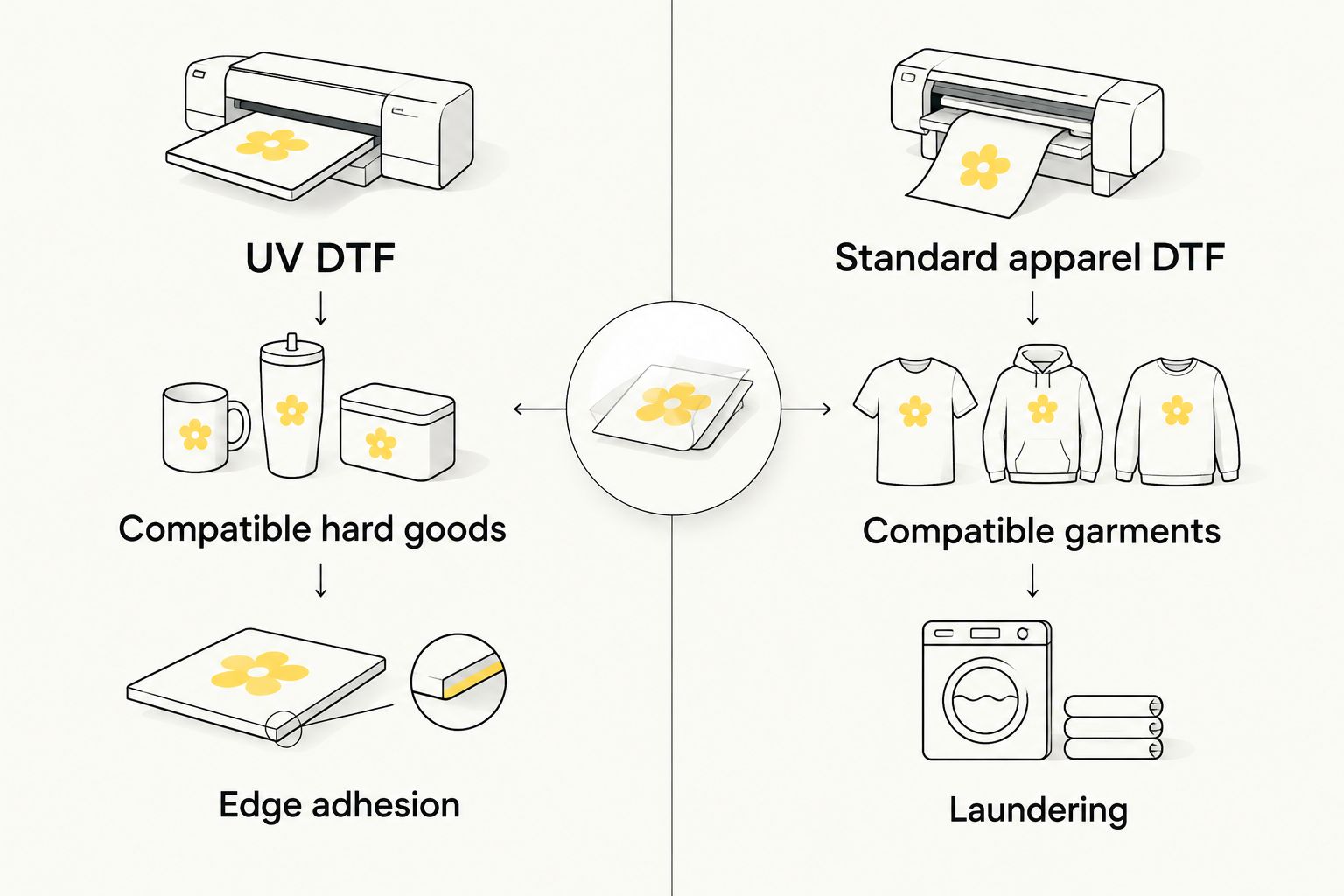
UV DTF: best for compatible hard goods
UV DTF is the relevant option when you need to decorate a suitable rigid object rather than a garment. Its cured graphic and adhesive must work together with the object's surface. The coating on that surface matters as much as the material underneath.
The advantage is application fit; the limitation is surface dependence. A smooth object is not automatically compatible, and successful initial adhesion is not proof of long-term cleaning resistance. Test the finished blank, including its coating, rather than relying on a material label such as metal or plastic.
Inspect exposed edges, fine lettering, and areas that receive regular handling. A graphic that looks intact across its center can still fail your acceptance criteria if small details lift. Evaluate the design you intend to sell, not only an easy-to-apply test square.
For drinkware, separate ordinary handling from washing claims. Do not describe a decorated item as dishwasher-safe, microwave-safe, or suitable for food-contact areas without explicit documentation covering the finished application. Those are distinct suitability questions, not automatic benefits of UV curing.
Choose UV DTF for a compatible hard-goods job after adhesion and care testing—not because its name sounds tougher.
Standard DTF: best for compatible apparel
Standard DTF is the relevant option for shirts and other compatible textile products. Its durability depends on the transfer system, fabric, heat application, and subsequent care. Fabric movement makes flexibility part of the performance requirement, not an optional extra.
The advantage is apparel suitability; the limitation is sensitivity to application and fabric compatibility. A transfer that bonds correctly to one garment is not proof that the same settings suit every fabric blend, surface treatment, or construction. Follow the transfer supplier's instructions and check the garment's limits.
Watch for edge lifting, visible cracking, adhesive separation, and unacceptable changes after laundering. Also assess how the decorated fabric moves during normal wear. An aggressive stretch test that exceeds the garment's intended use is not a substitute for a relevant wear assessment.
For your 2026 apparel orders, keep the transfer and blank combination attached to the test record. Changing the garment while retaining the old approval leaves a gap in your production evidence.
Choose standard DTF for compatible apparel, then approve the complete pressed garment—not the loose transfer alone.
Why UV DTF and standard DTF durability varies
The process name identifies a decoration method, not a universal service-life rating. These factors determine what you need to qualify:
- Substrate compatibility: The adhesive contacts the actual finish, coating, or fabric surface. A broad material description does not capture every compatibility issue.
- Application quality: Standard DTF requires the specified heat-press process. UV DTF requires the specified surface preparation and transfer procedure. Departures from either process undermine a useful comparison.
- Mechanical stress: Garments bend and stretch; decorated hard goods encounter handling and rubbing. Test the stresses the finished item will actually experience.
- Cleaning conditions: Laundry, hand washing, and dishwasher exposure are different conditions. Approval under one does not establish suitability under another.
- Environmental exposure: Sunlight, heat, moisture, and cleaning chemicals introduce separate demands. UV curing alone does not establish resistance to those conditions.
- Artwork and placement: Fine details and exposed edges deserve inspection. A design placed where it repeatedly rubs against another surface needs a different assessment from a protected decoration.
Control these variables before comparing suppliers. Otherwise, a change in blank, application, or care can look like a difference in transfer quality when the test conditions were never equivalent.
How should you test durability before production?
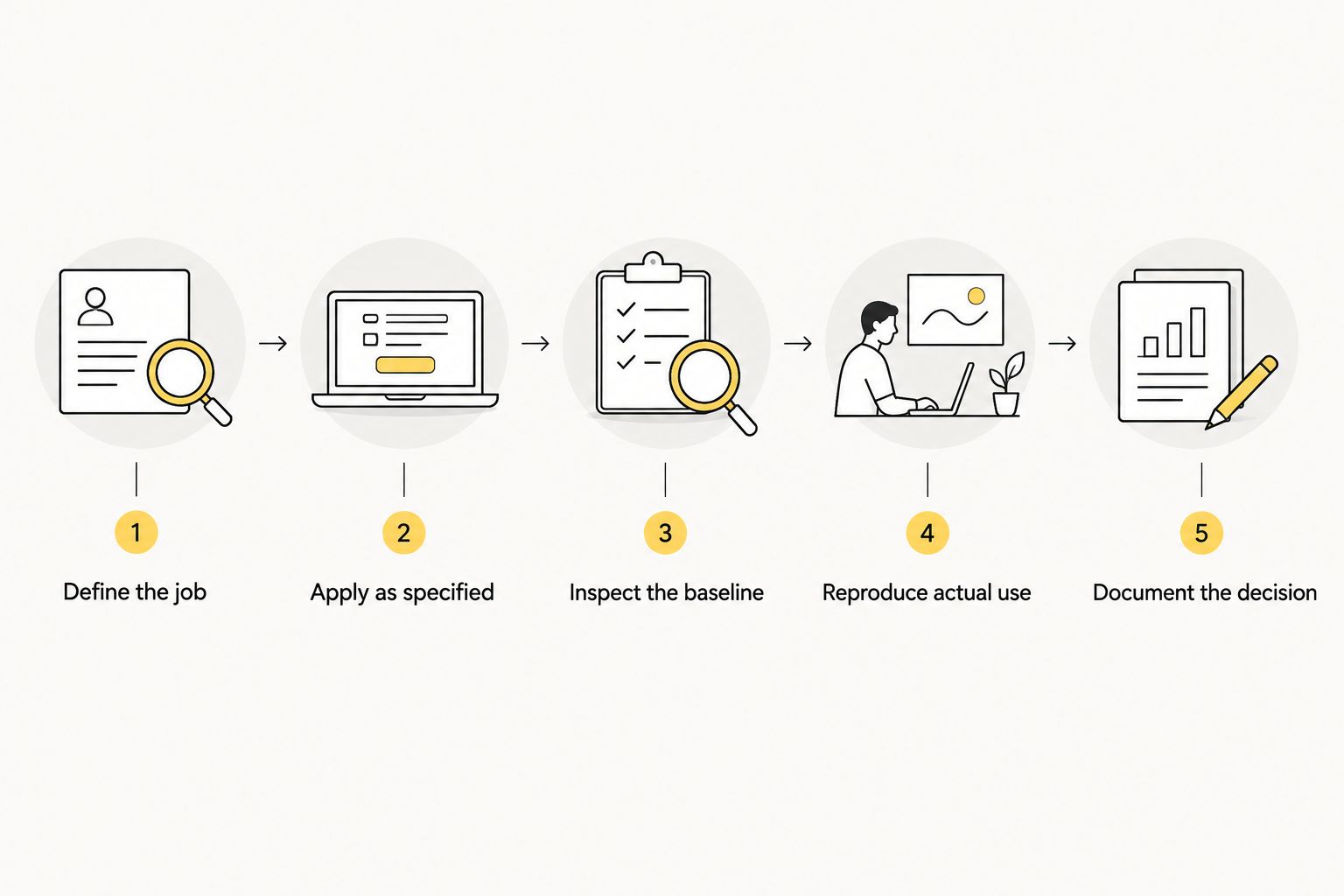
Build your 2026 approval around the finished product and the customer's intended use. Keep the procedure repeatable so a later reorder can be assessed against the same requirements. Do not convert an informal shop test into a certified performance claim.
Define the job
Write down the exact blank, decoration location, transfer type, artwork, and expected care. Identify whether the job is washable apparel, hand-cleaned hard goods, or an item with another documented requirement.
Set acceptance criteria before testing. Decide what counts as unacceptable lifting, cracking, fading, or surface damage; otherwise, the same result can receive different decisions from different operators.
Apply as specified
Use the transfer supplier's current instructions. For apparel, record the press settings, peel procedure, and any finishing steps specified for that transfer. For UV DTF, record surface preparation and the application method.
Do not improvise extra heat, coatings, or treatments to rescue an unqualified combination. A modified application needs its own assessment. If apparel adhesion fails, use the guide to troubleshooting DTF transfers that are not sticking to structure the diagnosis.
Inspect the baseline
Photograph the decoration before use under consistent lighting. Record edge condition, fine-detail attachment, visible defects, and the appearance of the blank itself.
Keep an unexposed comparison item when practical. That reference helps distinguish a genuine change from differences in lighting or memory. It also helps separate damage to the decoration from damage to the underlying object.
Reproduce actual use
Launder apparel according to the applicable care instructions. Clean hard goods only by methods supported for that application, then inspect the areas that receive handling or rubbing.
Record the actual exposure rather than writing only pass or fail. Keep fabric-flex testing separate from hard-surface scratch testing; combining unlike tests into a single durability score hides what each result means.
Document the decision
Compare the result with your predefined acceptance criteria. Photograph changes, identify the tested combination, and retain the application record with the job.
Approve only the conditions you tested. Passing a hand-wash assessment does not justify a dishwasher claim, just as an initial garment inspection does not establish wash durability.
Which transfer should your shop source?
Choose by finished product first, then qualify durability. For apparel production, ask DTF2GO for application guidance relevant to your garment and transfer choice. For a hard-goods job, request documentation for the actual surface and expected cleaning conditions rather than borrowing apparel performance claims.
The options below represent different decoration workflows. PRINT & CUT DTF Transfers fit an apparel-transfer workflow; Premium UV-DTF Transfers belong in the hard-goods evaluation. Neither product name establishes a comparative lifespan, and neither removes the need to qualify your blank.


Does UV curing mean UV DTF will last longer outdoors?
UV curing does not establish outdoor durability. Curing describes how the ink is hardened; outdoor performance concerns how the finished decoration withstands exposure after application.
For a 2026 exterior job, request documented suitability for the ink, adhesive, substrate, and exposure involved. Do not turn a process description into a promise about fading, weathering, or service life. If exterior performance is a customer requirement, make it an approval condition before production.
Is standard DTF better for clothing that gets washed?
Standard apparel DTF is the appropriate category for compatible clothing that requires laundering. UV DTF hard-goods decoration is not a replacement for a garment transfer merely because its printed surface feels hard.
Qualify the garment after pressing and laundering according to the relevant instructions. Initial color and adhesion matter, but they do not answer whether the finished decoration meets your customer's ongoing care requirements.
What evidence should you request from a transfer supplier?
Ask for the tested substrate, application procedure, cleaning or exposure method, and the definition of failure. Request the date and scope of any performance report. A result without those details is difficult to apply to a production decision.
Separate supplier evidence from your own qualification record. Supplier documentation helps you select a candidate; your shop's test checks whether that candidate works with your blank, artwork, equipment, and intended use.
For 2026 purchasing, prefer a specific, relevant test over an unsupported claim of maximum durability. Ask what failed as well as what passed. A useful technical answer identifies limitations instead of treating every surface and care method as interchangeable.
FAQ
Is UV DTF more durable than regular DTF?
UV DTF is not universally more durable than regular apparel DTF. UV DTF serves compatible hard goods, while standard DTF serves compatible textiles; durability depends on the finished application and its use.
Can I use UV DTF transfers on T-shirts?
UV DTF hard-goods transfers are not a substitute for standard apparel DTF on T-shirts. Use a transfer system explicitly intended for the garment and follow its application instructions.
Does UV DTF mean the print will not fade in sunlight?
UV DTF does not automatically establish resistance to sunlight or fading. UV curing describes the ink-hardening process, not a guaranteed outdoor service life.
Are UV DTF transfers automatically dishwasher-safe?
UV DTF transfers are not automatically dishwasher-safe. Require explicit documentation covering the transfer, substrate, and cleaning conditions before making that claim.
How many washes will standard DTF last?
Standard DTF does not have a universal wash-life figure. Fabric compatibility, transfer construction, application, and laundering conditions must be specified before a wash-durability claim is meaningful.
Does DTF2GO sell both apparel DTF and UV DTF transfers?
DTF2GO lists PRINT & CUT DTF Transfers and Premium UV-DTF Transfers. Select the category that matches your finished product, then confirm application and care requirements.
What should I check first when a transfer starts peeling?
Check substrate compatibility and application compliance first. Compare the actual preparation and application record with the transfer supplier's instructions before changing the process.
One last thing
A print that looks perfect immediately after application has passed an appearance check—not a durability test. That distinction applies to both UV DTF and standard apparel DTF.
Keep a retained reference from the approved job and compare future production against it. When the blank, transfer system, application procedure, or customer care requirement changes, reassess the combination instead of carrying the old approval forward automatically.


