


DTF printing is better for cotton, dark garments, and mixed-fabric apparel orders; sublimation is better for light-colored polyester when you want a print with no added surface layer. The trade-off is hand feel versus substrate flexibility: DTF leaves an adhesive-backed print on the garment, while conventional sublimation depends on polyester or a compatible coating. For dtf vs sublimation printing in 2026, choose the garment and required finish first—not the printer.
- DTF wins for cotton and dark apparel; sublimation wins for light polyester with no added print layer.
- DTF vs sublimation printing comes down to fabric composition, garment color, and required hand feel.
- DTF2GO is best for apparel decorators who want custom, ready-to-press DTF transfers instead of producing transfers in-house.
- Neither method wins every job: test the actual blank before committing a customer order.
Why this matters
A sharp print on the wrong blank is still a failed production choice. Your decoration method determines which garments you can accept, how the print feels, and what you must control at the heat press.
Start with the fabric label. If your order is cotton, the DTF transfers for cotton T-shirts guide addresses the relevant substrate rather than treating every heat-transfer process as interchangeable.
Is DTF printing better than sublimation printing?
DTF wins on garment flexibility; sublimation wins on an uncoated fabric feel. Neither is the universal replacement for the other. This 2026 comparison applies to conventional apparel DTF and dye sublimation, not specialty hybrid systems marketed under similar names.
| Production requirement | DTF printing | Sublimation printing | Best for |
|---|---|---|---|
| Cotton apparel | Adhesive-backed transfers can decorate compatible cotton blanks | Conventional sublimation does not permanently dye untreated cotton fibers | DTF for cotton jobs |
| Dark garments | A white ink underbase supports visible color | Standard sublimation has no white ink; dark fabric masks the design | DTF for dark apparel |
| Light polyester | Suitable transfers can decorate compatible blanks; test for dye migration | Dye enters the polyester rather than adding a film | Sublimation for light polyester |
| Large graphics with minimal print feel | A broad solid graphic adds a noticeable surface layer | No separate adhesive-backed print layer | Sublimation for compatible performance apparel |
| Mixed-fabric orders | Broader substrate flexibility, subject to blank and transfer compatibility | Results depend on polyester content and garment color | DTF for varied apparel orders |
| Coated hard goods | Apparel DTF is not a universal hard-surface process | Works with appropriately coated sublimation blanks | Sublimation for compatible promotional goods |
The practical distinction is where the decoration sits. DTF transfers a printed layer bonded to the surface with adhesive. Sublimation colors compatible material through heat-driven dye transfer.
That difference explains both methods' strengths and limitations. DTF supplies opacity and fabric flexibility; sublimation avoids a separate print layer but gives you less freedom to choose the substrate.
DTF printing: best for cotton, dark garments, and mixed orders
Choose DTF when your order includes cotton tees, dark sweatshirts, or different garment compositions carrying the same artwork. A white ink underbase gives the color image an opaque foundation, so the design does not depend on a white shirt for visibility.
A 100% cotton shirt is a clear example. Conventional sublimation cannot permanently dye its untreated cotton fibers, while an appropriately specified DTF transfer uses adhesive bonding rather than polyester dye affinity.
DTF also suits artwork with multiple colors, gradients, and photographic elements. You still need a production-ready file. Small lettering, thin lines, and isolated details require checking at final print size rather than judging an enlarged screen preview.
The limitation is the layer you leave behind. Large solid graphics feel different from bare fabric and cover the underlying knit. Artwork with open areas generally leaves more uncovered fabric than a solid rectangle occupying the same overall space.
Do not treat substrate flexibility as permission to press everything identically. Coatings, stretch, seams, heat sensitivity, and polyester dyes still affect the result. Confirm the transfer instructions and the blank's decoration guidance before production.
Sublimation printing: best for light polyester and minimal hand feel
Choose sublimation when the blank is compatible, light-colored polyester and the customer wants the graphic to feel like the surrounding fabric. A white 100% polyester shirt is the clearest apparel example: it provides both receptive fibers and a light base for the image.
Because sublimation does not add an adhesive-backed film, there is no separate print layer to lift at the edges. That does not make the garment indestructible. The fabric and dye remain subject to wear, care practices, and exposure.
The restriction is the substrate. A shirt containing 50% polyester is not equivalent to a 100% polyester shirt: the polyester portion accepts sublimation dye, while the untreated cotton portion does not. Do not translate polyester percentage into a promised percentage of color strength; fabric construction and processing also matter.
Dark apparel is another hard limit for conventional sublimation. Standard sublimation does not print an opaque white foundation. The garment color therefore remains part of the image and can overwhelm lighter design elements.
Sublimation wins when the blank suits the process—not when you need the process to rescue an incompatible blank. For promotional goods, use products specifically intended for sublimation rather than assuming any ceramic, metal, or plastic surface will accept the dye.
Why the better printing method varies by job
Your 2026 production decision should follow the order specification. These factors change the answer without requiring a blanket claim that one process is better:
- Fabric composition: Cotton favors DTF; light polyester supports sublimation. Blends require evaluating their actual composition and finish.
- Garment color: DTF's white underbase supports dark apparel. Conventional sublimation depends on a light substrate for clear color reproduction.
- Print coverage: A large solid DTF image adds more covered surface than separated design elements. Sublimation avoids that added layer on compatible fabric.
- Garment performance: Stretch, heat sensitivity, coatings, and existing dyes affect decoration suitability. Test the specific blank, not just its fabric category.
- Production ownership: Buying ready-to-press DTF transfers separates transfer manufacturing from garment application. Producing either method in-house adds its own equipment and process controls.
- End product: Apparel DTF and coated sublimation hard goods serve different applications. Match the process to the item rather than treating transfer terminology as a compatibility guarantee.
These factors also explain why a decorator can use both methods without duplicating their purpose. Assign cotton and dark apparel to the appropriate DTF workflow, and reserve sublimation for compatible orders where its fabric feel is the deciding advantage.
How do you choose between DTF and sublimation for an order?
Use this sequence before quoting or approving artwork. The blank sets the boundaries; the customer brief selects the finish. Record the decision with the job so a repeat order does not depend on memory.
- Check the blank. Read the fabric label and decoration guidance. Identify coatings, stretch panels, seams, and other features that affect pressing.
- Check garment color. Decide whether the artwork needs an opaque white foundation. Dark apparel usually points toward DTF rather than conventional sublimation.
- Check print coverage. Review the design at its intended size. Ask whether a surface print is acceptable or whether the customer requires an uncoated fabric feel.
- Choose the workflow. Separate printing transfers from applying them. Decide which steps belong in your shop and which you will source.
- Approve a sample. Decorate the actual blank using the relevant instructions. Check appearance, hand feel, adhesion where applicable, and performance after appropriate laundering.
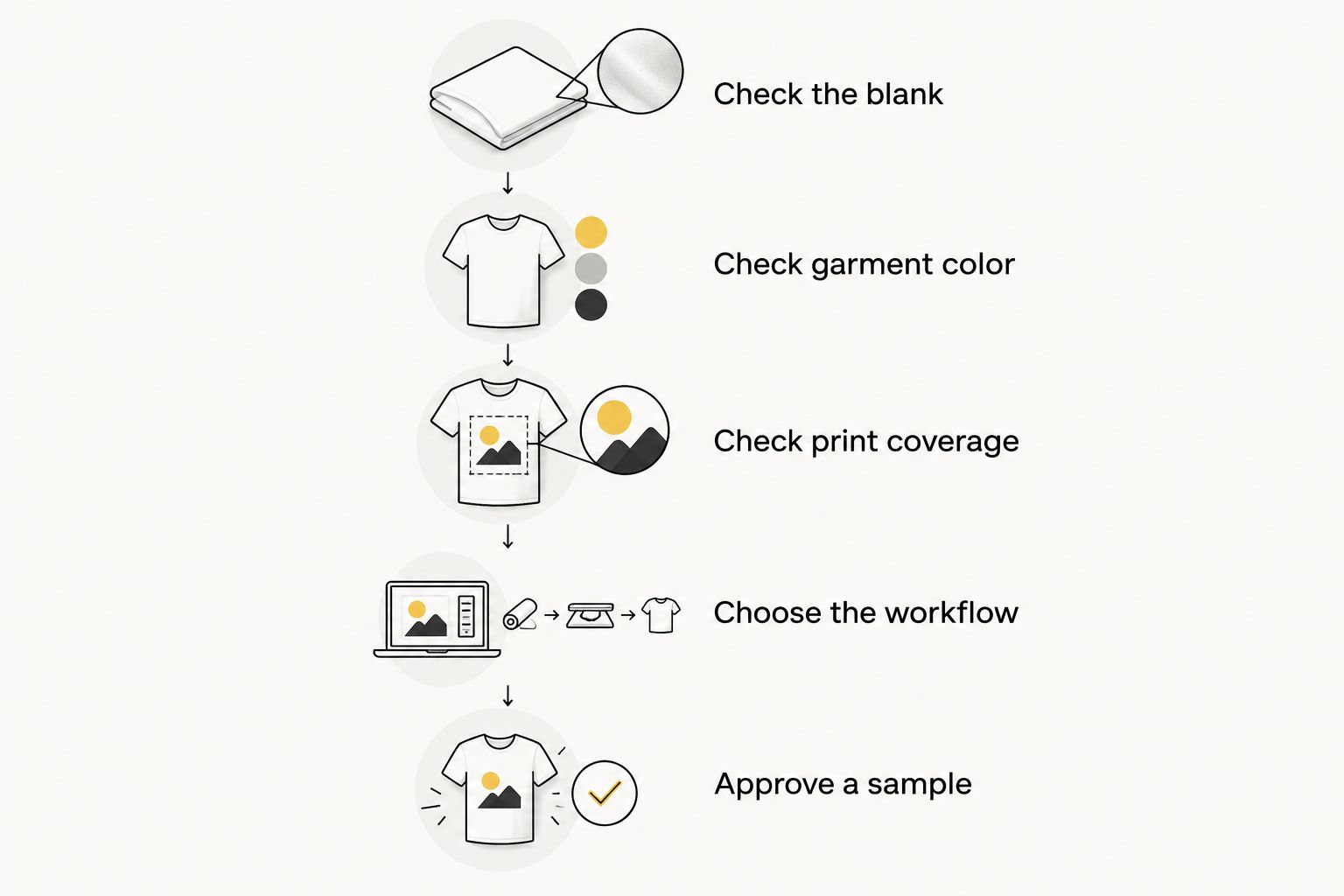
A sample is not just a color check. Examine the print on the worn garment, including areas that bend or stretch. A design that looks clean laid flat can feel unsuitable once the customer wears it.
Retain the approved garment specification and process notes. In 2026, a repeat order with a different blank still needs review even when the artwork has not changed. Matching a product description is not the same as confirming identical decoration behavior.
Does sublimation feel softer than DTF?
Sublimation has no added print layer on compatible polyester; DTF leaves a bonded surface layer. If the customer requires essentially the original fabric feel through the image area, sublimation has the stronger fit—provided the garment supports it.
DTF hand feel depends on the transfer construction, artwork coverage, and garment. Avoid turning that into an unsupported promise that every DTF transfer feels alike. Compare an actual decorated sample with the blank.
For DTF artwork, negative space is useful. Separate lettering and open shapes leave fabric exposed, whereas a continuous printed background covers the whole image area. Change the artwork only with customer approval; preserving the design remains part of the job.
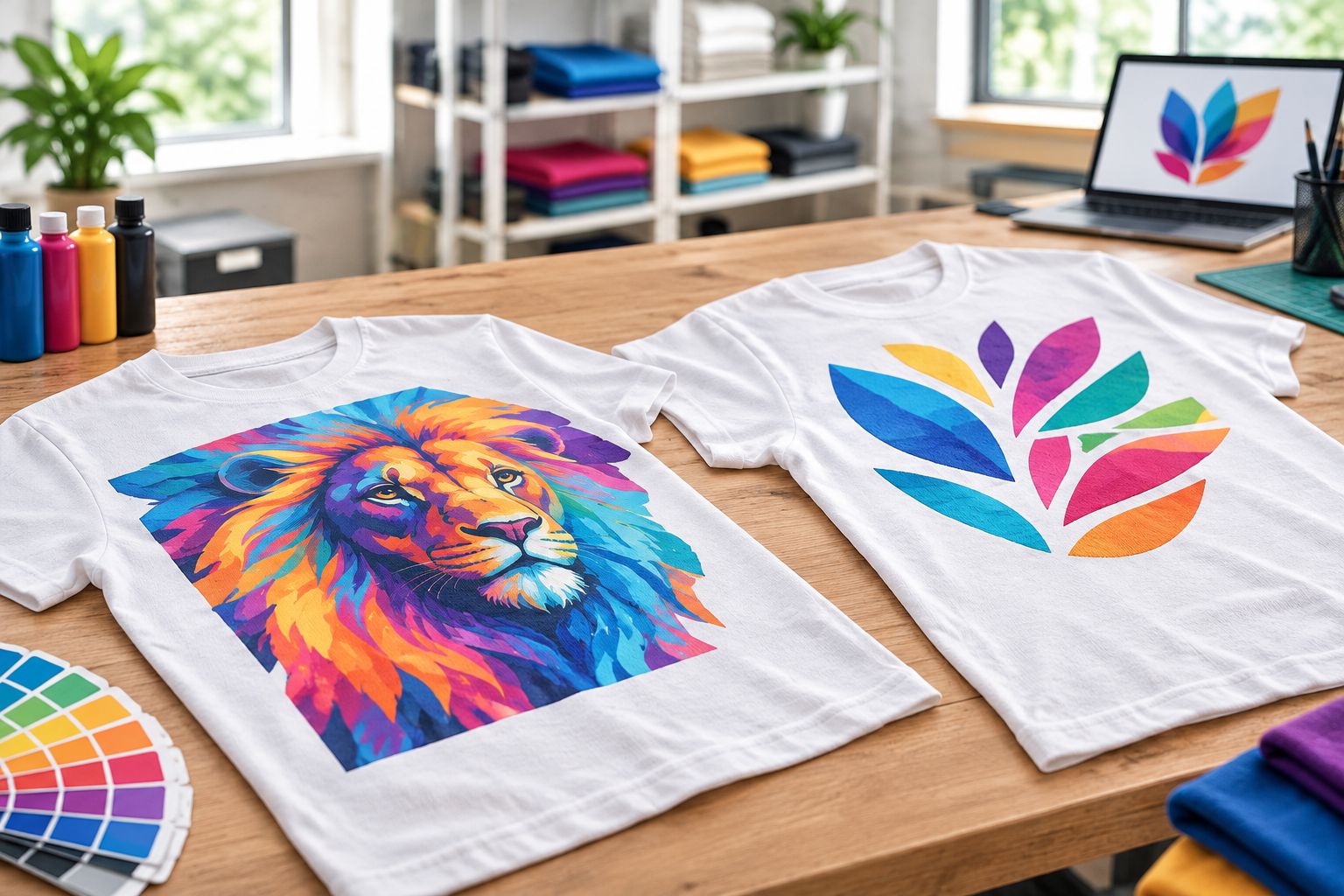
Print coverage and print chemistry are separate choices. An open DTF design can reduce covered fabric, but it does not turn the transfer into sublimation. Keep that distinction clear when discussing hand feel with customers.
Does DTF last longer than sublimation?
Neither DTF nor sublimation has a universal wash-life advantage across every garment. Properly applied DTF depends on a sound bond and suitable care; sublimation has no adhesive-backed print layer to peel, but its appearance still depends on the substrate and use.
Inspect different failure modes. DTF checks include edge lifting, cracking, and changes under normal garment stretch. Sublimation checks include color changes, ghosting from application, and the condition of the fabric itself.
Do not promise a fixed wash count without evidence for the exact transfer, garment, application, and care conditions. An approved production sample provides a more relevant basis than a lifespan claim copied from an unrelated product.
Can ready-to-press DTF replace an in-house sublimation setup?
Ready-to-press DTF can cover compatible apparel jobs that sublimation cannot; it does not replace sublimation's uncoated finish or coated-hard-goods applications. Separate the methods by job suitability instead of retiring one because the other has broader apparel compatibility.
DTF2GO is best for apparel decorators who want custom, ready-to-press DTF transfers instead of producing transfers in-house. Its individual cut-to-size DTF transfers fit that sourcing model: the transfer arrives ready for the garment-application stage.
The advantage is a defined division of work. The supplier produces the transfer; your shop selects the blank and controls placement and pressing. The limitation remains the DTF surface layer, and outsourcing transfer production does not remove the need for application testing.
For your 2026 workflow, judge outsourced transfers and in-house sublimation against the jobs they actually serve. Track your own preparation, application, inspection, and rework requirements rather than assuming either route is automatically faster.
FAQ
What's better for cotton shirts, DTF or sublimation?
DTF is better for conventional decoration of untreated cotton shirts. A 100% cotton blank does not provide the polyester fibers conventional sublimation needs for permanent dye transfer; use a compatible DTF transfer and verify application instructions.
Is sublimation better than DTF for polyester sports shirts?
Sublimation is better for light-colored, compatible polyester sports shirts when minimal print feel is the priority. DTF remains an option for compatible garments needing an opaque graphic, but broad print coverage adds a surface layer.
Can I use sublimation on a black shirt?
Conventional sublimation does not produce an opaque image on a black shirt because it has no white ink foundation. For a visible full-color design on compatible dark apparel, DTF is the better fit.
Does DTF printing crack while sublimation doesn't?
DTF has a surface print layer that can crack under unsuitable application, use, or care conditions; sublimation has no separate film layer to crack. That difference does not establish a universal durability ranking for finished garments.
Do I need a DTF printer to use DTF2GO transfers?
You do not need a DTF printer to apply DTF2GO ready-to-press DTF transfers. You still need an appropriate application setup, a compatible blank, and the transfer's pressing instructions.
Can the same heat press handle DTF and sublimation?
A heat press can serve both methods if its operating range, pressure control, and platen arrangement meet each job's requirements. Follow the respective transfer and blank instructions rather than reusing one method's settings for the other.
What's the deciding factor in DTF vs sublimation printing in 2026?
The deciding factor in DTF vs sublimation printing in 2026 is the combination of substrate compatibility and required finish. Choose DTF for compatible cotton and dark apparel, and sublimation for light polyester when an added print layer is unacceptable.
One last thing
White in the artwork means different things in these processes. With DTF, white ink can form part of the image and its underbase; with conventional sublimation, an unprinted white area relies on the blank being white.
Check that detail before approving a proof. If the customer's logo requires white elements on a colored garment, choosing the wrong process changes the logo—not just the production workflow.


