


Yes, you can apply a DTF transfer over some existing screen prints, but only after confirming that the ink surface, garment, and transfer are compatible. The extra layer does not repair cracked ink or guarantee adhesion, and another heat cycle can affect the original decoration. Treat printing over screen print as a tested rework process—not a standard application to blank fabric.
- Can you DTF print over screen print? Sometimes, but approve the actual ink-and-transfer combination before production.
- A new DTF transfer cannot stabilize an existing screen print that is peeling or cracking.
- Placing new artwork on undecorated fabric avoids bonding directly to the original ink.
- DTF2GO supplies ready-to-press DTF transfers; screen-print overlays still require application testing.
Can DTF transfers be applied over existing screen print designs?
DTF transfers can be applied over an existing screen print when the transfer adhesive bonds to that particular surface and the complete decoration survives testing. A successful peel is not sufficient evidence. You also need to check the cooled print, normal garment movement, and laundering under the applicable care instructions.
The distinction is the bonding surface. On a blank shirt, the transfer contacts fabric; on an overprint, some or all of the adhesive contacts cured screen-print ink instead.
| Application option | Best for | Advantage | Limitation | Recommendation |
|---|---|---|---|---|
| DTF on undecorated fabric | Adding a separate logo or name | Avoids an ink-to-transfer bond | Requires space outside the original design | Prefer this placement when practical |
| DTF over a smooth, intact screen print | Evaluating a cover-up or correction | Keeps the proposed artwork in the original location | Adhesion and appearance need validation | Test before approving |
| DTF over raised or textured ink | Specialty-print evaluation | Allows a physical trial of the proposed combination | Uneven surfaces complicate contact and coverage | Require specific application guidance |
| DTF over cracked or peeling ink | Assessing an unsuitable rework candidate | No reliable repair benefit | The underlying decoration remains unstable | Skip the overlay |
Why this matters
A cover-up creates a layered decoration. The new transfer depends on its bond to the original print, while the original print still depends on its bond to the garment. A strong top layer cannot compensate for a failing layer underneath.
For 2026 rework orders, separate visual approval from application approval. A customer can approve the replacement artwork while the physical application still fails testing.
DTF2GO is best for apparel decorators sourcing custom, ready-to-press DTF transfers. That sourcing fit does not establish compatibility with an unknown screen-print ink; approval belongs to the complete garment-and-decoration combination.
Smooth, intact screen prints: test the actual surface
A flat, well-attached print is a more practical test candidate than a peeling or heavily textured design. Start by checking the existing decoration for loose edges, cracks, contamination, and visible differences between garments. Do not treat a smooth appearance as proof of adhesive compatibility.
Identify the ink system when production records are available. Plastisol, water-based, and specialty screen-print inks do not describe an identical finished surface, and even an ink-family name does not establish compatibility with a particular transfer.
Best for: controlled rework trials on garments with a known decoration history. The advantage is a relatively even application surface; the limitation is that a flat print can still reject an adhesive or change under heat.
Raised or specialty screen prints: confirm guidance first
Puff, high-density, glitter, and other textured decorations introduce a different contact surface from a flat print. Raised features can prevent the transfer from contacting the entire intended area evenly. The original texture can also remain visible beneath a cover-up.
Do not try to flatten an unknown specialty print by increasing pressure or repeatedly pressing it. Confirm whether the original ink and the transfer support the proposed application before sacrificing a garment.
Best for: evaluation where the ink system is identified and application guidance supports testing. The limitation is both technical and visual: adhesion alone does not establish that the finished surface will meet the customer's expectations.
Cracked or peeling screen prints: use another garment
A transfer laid over damaged ink remains dependent on that damaged ink. If the original decoration separates from the fabric, the new decoration has no sound foundation in that area. Covering the defect does not remove it.
Inspect the garment while it lies flat and while the fabric moves gently. Existing cracks, loose flakes, and lifting edges are reasons to reject the overlay rather than reasons to add more heat.
Best for: choosing a replacement blank or a different decoration location—not approving a cover-up. A fresh garment avoids the unstable base, although it requires replacing rather than rescuing the original piece.
Why DTF-over-screen-print results vary
Evaluate these factors together. None establishes compatibility on its own:
- Existing ink condition: a stable-looking print still needs testing; a visibly failing print should not become the foundation for another decoration.
- Surface profile: smooth and raised areas present different contact conditions beneath the press.
- Garment composition: the fabric must tolerate the transfer's required application process, regardless of what is already printed on it.
- Application instructions: temperature, dwell time, pressure, peel method, and any finishing press must match the transfer supplier's guidance and the approved substrate.
- Artwork coverage: transparent spaces leave the original design visible, while solid coverage adds another decorated layer.
- Service conditions: assess the finished garment under the washing and use conditions you intend to approve.
A transfer supplier's instructions for blank cotton do not automatically validate application over screen-print ink. The substrate at the bond line has changed.
How do you test a DTF transfer over screen print?
Use a documented trial before accepting the production order. Reserve at least 1 sacrificial garment for each distinct garment, existing-print, and transfer combination as an initial screening step—not as a durability guarantee or a statistical sampling plan.
Keep the test representative. A spare shirt with a different ink deposit or garment composition does not answer the question for the customer's actual stock.
Identify the stack
Record the garment composition, existing decoration type when known, transfer identification, and relevant supplier instructions. Photograph the original print before applying anything. Include the actual screen-print location and condition on the 2026 job ticket so another operator can reproduce the trial.
Check for conflicting application requirements before pressing. If the garment or original decoration cannot tolerate the transfer's required process, stop rather than inventing a compromise setting.
Check the artwork
View the proposed cover-up against the entire old design, not just its center. Transparent areas in a DTF design do not conceal the print underneath, and an outline that barely matches the old graphic leaves little room for placement variation.
Check opacity, alignment, and the visibility of the original print's edges on the physical sample. Screen previews cannot demonstrate the finished texture or hand feel of stacked decoration.
Compare placements
Where the garment allows it, compare 2 test placements: one over the existing print and one on undecorated fabric. Use the same transfer construction and documented application method for both. This comparison helps distinguish a problem associated with the old print from a broader application problem.
The undecorated placement is a reference, not proof that the overlay is acceptable. Both locations still need inspection.
Apply as directed
Use the supplier's stated application instructions for the approved combination, including the correct peel method and any required finishing step. Protect the existing decoration as directed; do not assume every cover sheet or pressing arrangement suits every ink system.
Record what you actually used. Do not substitute a generic internet temperature or add repeated press cycles simply because an edge lifts.
Inspect and launder
Use 3 approval checkpoints: cooled inspection, gentle movement, and laundering. Inspect the cooled decoration for lifting, bubbles, surface damage, visible outlines, and unwanted color changes. Then check ordinary garment movement without forcing an extreme stretch.
Launder according to the applicable garment and decoration instructions, observing any required waiting period first. Record the wash conditions and results rather than describing the sample as wash-tested without a defined procedure.
Approve or reject
Approve only the tested combination and the conditions documented for it. Reject samples that lift, separate, damage the original print, or fail the customer's appearance requirements. Retain the approved sample as a production reference.
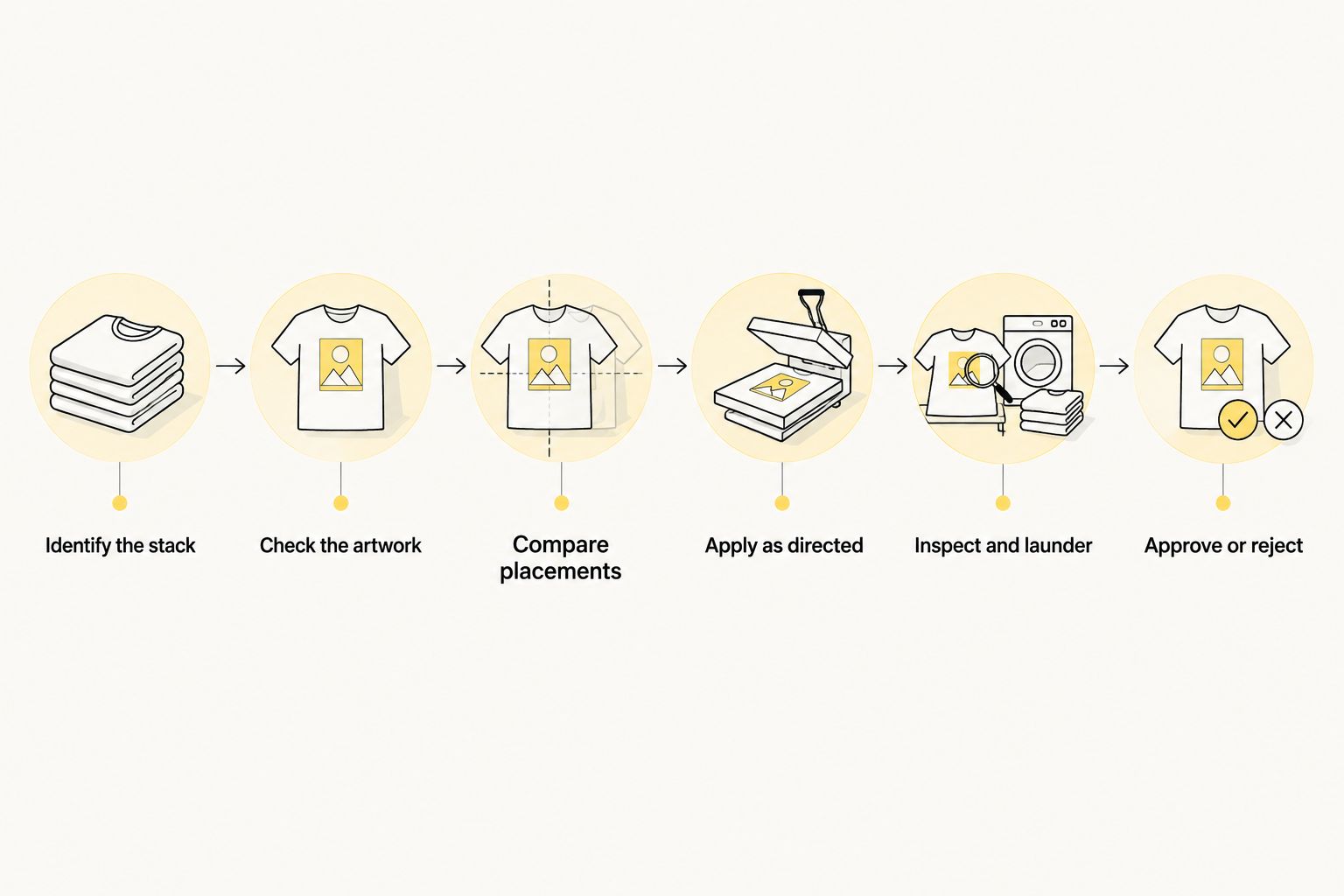
Your 2026 production checklist should distinguish initial screening from the durability standard required for the order. Passing an early inspection does not establish a guaranteed service life.
What should you do if the transfer lifts?
Stop and identify where separation occurred. A lifted DTF edge, an old screen print pulling away from fabric, and visible damage to the garment are different failures. Treating all of them as insufficient pressure hides the actual problem.
Compare the overlay with the undecorated test placement. If the reference placement bonds but the overlay does not, investigate the existing ink surface and the proposed combination before changing the press recipe. If both fail, review the transfer instructions, press operation, and garment suitability.
Use the DTF transfer adhesion troubleshooting guide to organize that review. Do not release a rework order because repeated pressing temporarily closes a lifting edge. Retest the corrected process through the same approval checkpoints.
Can you hide the old screen print completely?
Complete coverage requires more than placing a new graphic over the old one. The replacement design must cover the old footprint, its printed areas must provide suitable opacity, and the finished surface must meet the agreed appearance standard.
A solid background can cover areas that transparent artwork leaves exposed, but it also adds continuous decoration across that area. Compare the finished sample for stiffness, texture, and visible borders before approving the design.
DTF2GO produces custom cut-to-size, ready-to-press DTF transfers for apparel decorators and print shops. When planning a cover-up, prepare artwork around the actual garment sample; transfer format alone does not resolve compatibility or conceal an uneven base.
Is printing beside the old design better than covering it?
Printing on suitable undecorated fabric is the preferred starting point when the layout permits it. This avoids making the new decoration depend on adhesion to the existing screen-print ink, although the garment still needs normal application checks.
An adjacent name, sleeve graphic, or separate logo also preserves the original design rather than hiding it. Confirm the press arrangement protects any existing decoration exposed during application.
Does a successful overlay test apply to every shirt in the order?
No. Approval applies to the tested combination, not every garment that looks similar. Differences in garment composition, original ink, print condition, or transfer construction require review before you reuse the result.
For repeat orders in 2026, retain the approved sample and application record together. Recheck the process when a relevant material or production condition changes rather than relying on the customer's artwork file alone.
FAQ
Can you DTF print over screen print on a cotton shirt?
Yes, some combinations work, but cotton content alone does not establish compatibility. The transfer must bond to the existing ink surface, and the complete decoration must pass testing.
Can I put a DTF transfer over plastisol ink?
Treat DTF over plastisol as a combination requiring supplier guidance and physical testing. The ink-family name alone does not establish adhesive compatibility or heat tolerance.
Will a DTF transfer cover a cracked screen-printed logo?
Do not use a DTF overlay to repair cracked or peeling screen print. The new decoration remains dependent on the unstable layer underneath.
What temperature should I use to press DTF over screen print?
Use the transfer supplier's instructions only where the garment and existing decoration support that application. There is no universal overprint temperature that establishes compatibility with every ink system.
Can I use more pressure if the DTF transfer does not stick?
Do not increase pressure blindly to correct an unverified bond to screen-print ink. Identify the failure location, check the documented process, and retest before production.
Will the original screen print show through the DTF transfer?
The original print can remain visible through transparent artwork, insufficient coverage, or surface texture. Approve opacity and appearance on the actual garment rather than from an artwork preview.
Should I wash-test a DTF cover-up before selling it?
Yes, include laundering in the approval process using the applicable care instructions and any required waiting period. Document the conditions and inspect both the new transfer and the original decoration afterward.
One last thing
A cover-up changes the artwork, not the weakest bond underneath it. The most useful test result is not always a successful overlay; it can be an early rejection that keeps an unsuitable garment out of production.
Make that distinction part of your 2026 rework policy. When sourcing DTF2GO DTF transfers for a correction job, approve the garment, old print, new artwork, and application process together. If the old decoration is unstable, change the placement or replace the blank.


